



In a shocking move that raises serious human rights concerns, U.S. Immigration and Customs Enforcement (ICE) deported Venezuelan soccer player Jerce Reyes Barrios, despite his claims of persecution under Nicolás Maduro’s dictatorship.
Reyes Barrios had applied for asylum in the United States, seeking refuge from a regime that allegedly tortured him. Yet instead of being granted protection, he was forcibly removed and sent not to his home country, but to a prison in El Salvador.
If you appreciate independent, no-nonsense reporting that cuts through the spin, consider becoming a paid subscriber. Your support helps me continue exposing the facts that mainstream media won’t.
Subscribe
Read the full affidavit filed by his attorney:
Reyes Barrios, a young and promising soccer player, fled Venezuela after suffering political persecution. Under Maduro’s rule, Venezuela has been accused of widespread human rights violations, including torture, extrajudicial killings, and arbitrary detentions. According to the affidavit filed by his attorney, Reyes Barrios endured torture at the hands of the Venezuelan regime, a fate that has befallen numerous dissidents and public figures critical of the government.
Upon arrival in the U.S., Reyes Barrios applied for asylum—a right protected under international law for those facing persecution in their home country. There was no evidence that he had committed any crimes or had any affiliations with gangs. His only “offense” was seeking safety.
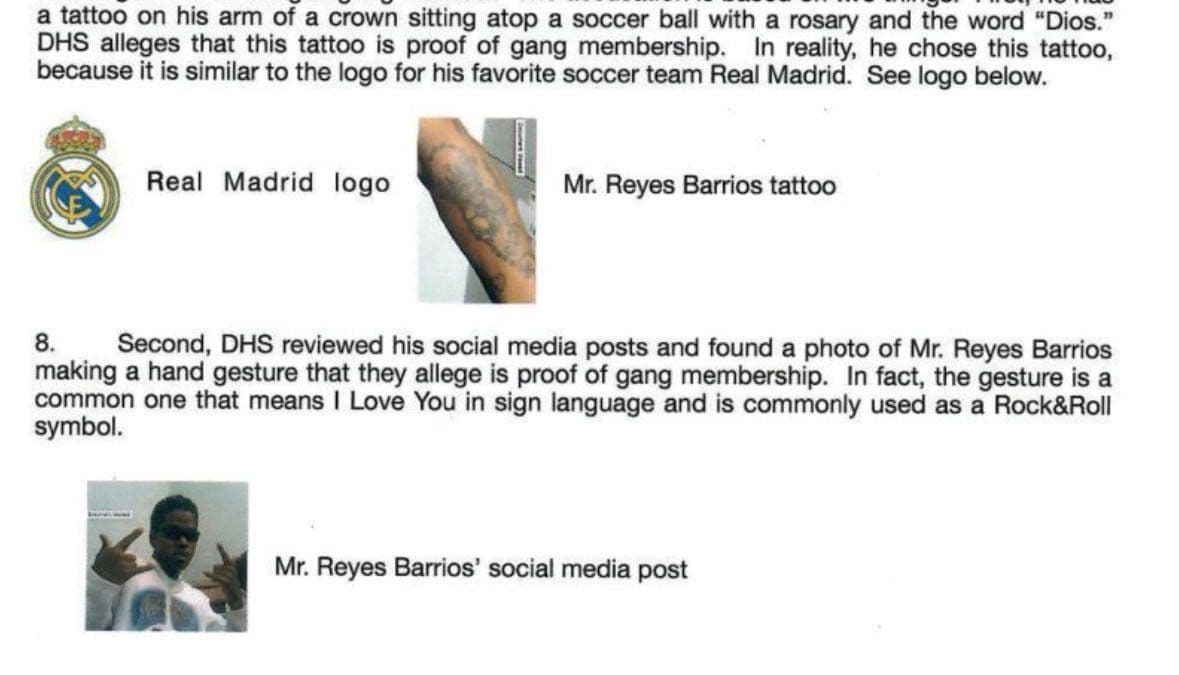
Under ICE policy, a person can be labeled a gang member if any ICE officer determines they meet two "Gang Membership Identification Criteria." In Reyes Barrios' case, those two so-called criteria were:
- A tattoo modeled off the Real Madrid logo, a reference to his love for soccer.
- A picture from social media of him throwing the horns, a common hand gesture used in music and sports culture.
That was it. Based on this weak and absurd reasoning, ICE designated Reyes Barrios as a gang member—effectively sealing his fate for deportation. There was no real investigation, no due process, and no actual evidence of criminal activity or gang ties.
Rather than being sent directly to Venezuela—a country where his life was in immediate danger—he was deported on one of the Alien Enemies Act flights and ended up in a prison in El Salvador. The reasons behind this decision remain unclear, but it raises concerns about the U.S. government's handling of asylum cases and its growing reliance on mass deportations to third countries.
Reyes Barrios' case is not an isolated incident. The Trump administration openly admitted to deporting individuals with no criminal history under the Alien Enemies Act, based solely on their tattoos. The broad and arbitrary use of gang labels has led to countless deportations of people who have no proven ties to criminal organizations, yet are treated as threats simply because of their appearance. Reyes Barrios’ case is just another example of how this system is abused, with devastating consequences.
Today, the federal government will submit answers to several questions posed by Judge James Boasberg. The government may invoke the state secrets doctrine to avoid submitting answers. I will have updates for you every step of the way.
The Parnas Perspective is a reader-supported publication. To receive new posts and support my work, consider becoming a paid subscriber.
Subscribe